
Project Description
Biography
Michael French
Michael French is an internationally recognized artist
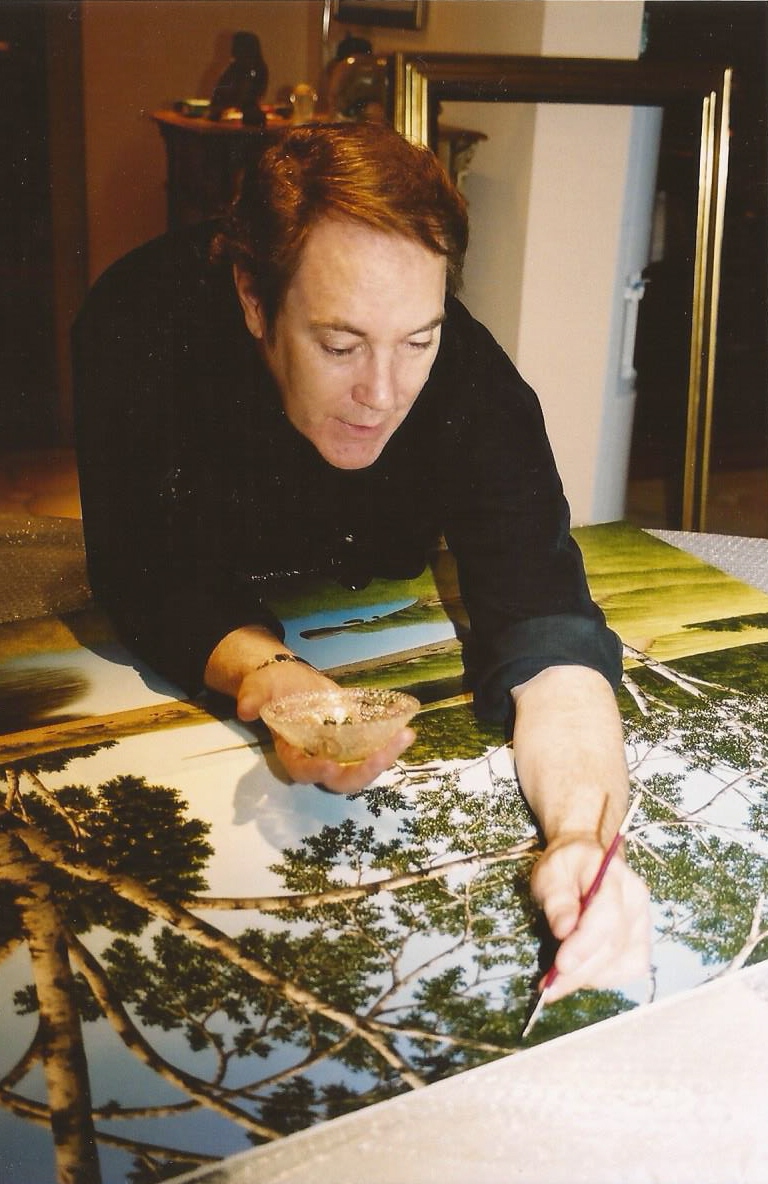
Michael French was born in 1951. Over the past 57 years he has exhibited in Toronto, Montreal, New York, Paris and San Miguel de Allende, Carmel and London. Michael moved to England in 1957 where he started school. His father, Dr. Barry French, was a professor and recipient of the Order of Canada, awards from NASA and the Canadian Space Agency. Michael´s mother, Gloria French, was a teacher in normal and specialized education most of her life. When Michael was young he lived and travelled with the family extensively throughout Europe which had an influence on his painting subjects in the years to come.
In 1972 Michael met the American hyper-realist, Andrew Wyeth, in South Cushing, Maine. In those days the American critics called the movement “magic realism”. Wyeth was supportive while giving Michael valuable advice regarding the art world and painting techniques. Wyeth was a tremendous influence in French’s earlier work. Michael corresponded with Mr. Wyeth, including sending him invitations and catalogues from major exhibitions Michael had in cities such as New York and Paris. In the same year that Michael met Andrew Wyeth, Michael joined the Roberts Gallery in Toronto where he exhibited for the next 25 years. At that time the Roberts Gallery was definitely one of the most prestigious galleries in Canada representing artists such as A.J.Casson, Lemieux and Tom Forrestal. The early shows in the Roberts Gallery coincided with a period of time in which Michael was homesteading in Newfoundland where he survived by hunting moose, caribou, waterfowl, caught fish. He cut and chopped firewood to heat his home, heat water and cook with. He spent about half of the day doing survival chores and the other half painting by natural light. Sometimes Michael would go into the country or Barrens of Newfoundland and lived off the land using his survival skills for two or three months at a time as well as drawing and photographing subjects for his paintings every day. All of his paintings from this period were painted on an art board composed of acid free paper. He painted in acrylic using watercolor techniques. His subjects then were often the ocean or landscapes, buildings, wildlife and people.
After the homesteading period he moved to Quebec on New Year’s day 1983 where he lived alternately between two residences, an apartment with a large bay window overlooking the Plains of Abraham in old Quebec City and a stone farmhouse dating back to the “Regime Français” on the Ile D´Orleans which had a view towards the estuary of the St. Lawrence River. During the Quebec years (1983 to 2002), Michael painted on solid acrylic panels. His subjects were similar to the Newfoundland subjects, but often were more surrealistic and painted from memory. In the mid 80’s, Michael entered the Basmadjian Gallery in Paris on the Blvd. Raspail. There he had group exhibitions and a major solo exhibition in 1987.
As a result, Richard Humphrey, a dealer from New York, invited Michael to exhibit in the Humphrey Gallery in the East Village. Michael exhibited there until the early 90s and had a major exhibition in the Humphrey Gallery when it opened the new location on Broadway in SoHo. After the Humphrey gallery years, Michael worked with James Whitfield in New York, as his agent who was a former dealer with the Findlay Gallery. Michael had two exhibitions in the Forbes Gallery Museum just north of Washington Square on Fifth Avenue in conjunction with Whitfield. Michael has had a long professional relationship and friendship with the Forbes family which exists to this day. The Forbes family, have acquired 18 of his paintings over the years. The last commission was a portrait of Adelaide Forbes, Christopher (Kip) Forbes´ granddaughter, in 2012. French had an exhibition in the Dennis Di Lorenzo Gallery just off Madison and 62nd where Robert Goelet, the chairman of the New York Historical Society acquired a painting and commissioned Michael to do a painting on Gardiners Island, which he and Alexandra his wife owned, off the Hamptons in New York. Michael worked with the Hammer Galleries in New York for many years after his exhibition in the year 2000 in the Forbes Museum. After Michael´s second exhibition in the Forbes Museum in 2008, he was represented by the Findlay Gallery in New York for a short period of time. In New York, Michael had four solo exhibitions (including two museum shows) and was represented by five different galleries and worked with the late James Whitfield for about 20 years as his agent from the beginning 90s to 2010.
At the end of 2002, Michael moved to San Miguel De Allende where he now resides partially with his Mexican/ Canadian family. He works in his studio most days except when on vacation which is often spent on his 46 foot Hinckley sailboat, sailing on the Pacific Coast of Mexico. His subjects include seascapes, or seascapes, street or urban scenes, still-lives and occasionally people The move to Mexico coincided with Michael´s work becoming more focused on hyper-realism than the partially surrealist work of the Quebec period. In Canada Michael worked with the Roberts Gallery for 25 years from 1972 to 1997. In 2005, Michael started working with the prestigious Kinsman Robinson Gallery in Toronto but the relationship ended with his last exhibition there in the fall of 2021 with the closure of the gallery because of the COVID pandemic. They had many successful exhibitions over those 15 years.
In 2021 Michael started working with Diplomat Treasures International Gallery in London, England. The owner and curator, Andre Van Hese, invited Michael to exhibit there after seeing his last exhibition in the Kinsman Robinson Gallery. Andre is an international authority on icons and is on the board of directors of ‘’ The Icon Museum and Study Centre ‘’ in Clinton, Massachusetts, which is the biggest icon museum in the US. Michael had two exhibitions with the DTI Gallery in the fall of 2023 and in the fall of 2024. Andre is a gallery director and senior international banker with the Mitsubishi Bank in London. In 2025 Andre exhibited Michael’s work in ‘’The Gallery’’ space on Church street in Marylebone, London which was used exclusively for Michael’s paintings.
In 2026 Michael entered into relationship with the Plus One Gallery in London which represents Michael exclusively all around the world except for a few paintings that Paul Robinson of the Kinsman Robinson gallery has in Canada. The Plus One gallery is a 1st string, international gallery that has cornered the majority of the world market in hyper-realism over the last 25 years and handles exclusively hyper-realist artists. Maggie Bollaert, who essential runs the gallery (with her team of course, including Colin and Maria) has published many books on hyper-realism and is accepted as an international authority on this genre by the public, her artists and peers.
Michael paints images from reality, carefully composing the compositions, looking at photographs he has taken of his subject before he even starts the painting process on panels. The next step Michael does after drawing the grisaille for the painting out on panel is to apply the airbrush under painting. Then, he paints in all of the sharp details, normally using 000 to number 2 brushes which is about 90% of the work in the painting. All of his paintings have many layers of paint; acrylic underneath and oil on top and he often glazes with oil paint. His work often reflects the influence of the great early 20th century European surrealists, such as Magritte. A noted aspect of his paintings is the extreme light which sometimes borders on the surreal. His work now figures prominently in major public and private collections around the world including those of His Majesty, King Charles III, estate Prime Minister Brian Mulroney and past President George W. Bush, who gave Michael´s commissioned portrait of President Bush to his Presidential Library. President George W. Bush invited Michael as a VIP guest to the inauguration ceremony of the Presidential Library. The MC was then Governor George Bush and the guest speakers were Nancy Reagan, Gerald Ford, Bill Clinton, Jimmy Carter and of course, George Walker Bush. Michael did the tour of the museum with Arnold Schwarzenegger and James Whitfield. In 1995, when the Forbes family started collecting Michael’s work, Christopher Forbes essentially became Michael’s patron in New York. Christopher Forbes presented one of Michael’s paintings to then, HRH Prince Of Wales. In 2011, one of Michael´s paintings, a street scene from San Miguel, was presented to President Felipe Calderón of Mexico and is now in his personal collection.
In the last 57 years Michael has had a total of 37 group exhibitions and 34 solo exhibitions since his first solo show in 1968 in the McCready Gallery in downtown Toronto.
In the last 55 years Michael has had a total of 37 group exhibitions and 33 solo exhibitions since his first solo show in 1968 in the McCready Gallery in downtown Toronto.
SOME PRIVATE COLLECTIONS |
| His Majesty, King Charles III of the UK. |
| President Bush Sr. Library, museum. |
| President Felipe Calderón of México. |
| Hon. Prime Minister Brian Mulroney, estate. |
| Hon. Frank Moores, estate. |
| Hon. John Aird, estate. |
| Hon. Barney Danson, estate. |
| Hon. Don Jamieson, estate. |
| Andre Van Hese , owner of Diplomat Treasures International gallery , London, UK. |
| Bill Breukelman, founder, past chairman of IMAX and Sciex with Dr. Barry French. |
| Robert and Alexander Goelet, estate (past President New York Historical Society) |
| Jim Thomson, founder Thomson trucking and Thomson Terminals. |
| Anne Murray, Singer, Performer. |
| Christopher and Astrid Forbes, past Chairman of Forbes Magazine. |
| Harold Henry Stream III. |
| Craig Dobbin, estate, Canadian Helicopter Corporation. |
| David Sobey, estate, Sobeys store. |
| Douglas Mackay, Estate( Former RBC Dominion Securities.) |
| Fraser Fell, Former RBC Dominion Securities. |
| Gordon Ritchie, ( past president RBC Dominion Securities, New York) |
| Garnet Watchorn, president, Graywoods and son Graham Watchorn |
| Stephan & Adriana Benediktson. |
| Susan Glass and Arni Thorsteinson, president, Canadian Shelter Co. (Member World Presidents Organization). |
| Duncan and Judy Jessiman, President, Bison Transport (Member World Presidents Organization). |
| William and Donna Lovatt, former CFO London Life and Great West Life. |
| Dr. Steven Funk, CEO Dignity Fund (Member World Presidents Organization). |
| Blaine and Barbara King, Former President Shoppers Optical. |
| Gerry Connor, Cumberland Management ( Royal Bank). |
| Gordon Ritchie, past President, RBC Dominion Securities, New York. |
| Irving Ungerman, Philanthropist, estate. |
| Jeanne Beker, Television Celebrity. |
| Professor and Dr. and Mrs. J. Barry French, past Dean of Graduate Studies, University of Toronto. |
| Kenneth Field, President, Invest Corp. |
| Jim Meekeson, President, Trimin Capital Corp. |
| Mark Wettlaufer, past President, Asset Management Toronto Dominion Bank, Fidelity Trust. |
| Moe Koffman, estate Flutist, Musician,. |
| Peter Widdirington, estate, past Deputy Commissioner of Major League Baseball, President Labatts. |
| Peter Bronfman, estate. ( Fonder of multiple companies and Hees International Bank) |
| Porus Kaka, international offshore tax lawyer, Mumbai, London. |
| Brian Robbins, Exco Technology Ltd. |
| Ron Meade, Altamira Mutual Funds. |
| David Graham, estate |
| Reay Mackay, estate, (past Vice Chairman RBC Dominion Securities) |
| John Rea, ( past CEO, Power Corporation). |
| Robin Korthals, (past President Toronto Dominion Bank) |
| Warren Thomson, (past Senior Ex VP and CIO, Manulife Financial Co.) |
| Timothy Danson, criminal and constitutional Lawyer. |
| Timothy Price, ( past Chairman Trilon Co.) |
SOME PUBLIC OR CORPORATE COLLECTIONS |
| Manu Life Financial Corporation. |
| CIBC Bank. |
| CIT Group. |
| AGF Management. |
| RBC ( Royal Bank) Dominion Securities. |
| Bank of Nova Scotia. |
| Davies, Ward, Phillips & Vineberg LLP. |
| Heenan Blakie LLP. |
| Fiera Capital. |
| Hiram Walker, ( Seagrams). |
| Lloyds Bank. |
| McCarthy Tetrault LLP. |
| Borealis Group. |
| CAE Industries. |
| Canada Capital. |
| SNC Lavalin. |
| Connor Clark & Lunn, ( Royal Bank Financial group.) |
| Xerox Corp. |
| Great West Life. |
| London Life. |
| Forbes Magazine corporate collection. |
Public |
| Agnes Etherington Art Center. |
| Art Gallery Of Ontario. |
| Musée d’art contemporain de Montréal (MAC). |
| Musée national des beaux-arts du Québec. |
| Lake of the Woods Museum, Kenora. |
| President Bush Sr. Library, Museum, Houston. |
| Harold Henry Stream III, Foundation collection. |
| Malcolm Forbes Sr. Mongolfier Museum, Chateau de Belleroy, Normandy, France |
Techniques
Michael’s paintings are always from images he has seen in real life. He extracts only the most important elements from memory or later from a photograph. By eliminating all of the extraneous or unimportant cluttering objects in a composition, Michael creates a reality that conveys a sense of harmony, balance and calm where the environment seems perfect or pristine. Photographs sometimes help by freezing the changing conditions such as changing light or flowers wilting, etc. Michael can study the unchanging photo image for a much longer period of time, which is necessary for highly detailed subjects such as the execution of a portrait. In Michael’s more recent hyper-realistic paintings this advantage is very important. Much of the art process, if using photographs, is in the original capture of the image. Still, working from memory, a photograph or reality, what is really essential is the composition that incorporates balance, negative and positive, color balance and the design, lighting and textures, all of which have to reflect the image forming in the artist´s mind.
Michael painted on acid free art board panels for approximately the first fifteen years of his career. He then painted on sanded acrylic panels for almost another twenty years. In the last thirteen years, Michael has returned to painting on acid free art board panels that he has specially constructed. The image from the photograph or from his mind is usually transferred( by a very light 3H line drawing) by pencil to the art panel. Some artists like Vermeer used lenses to accomplish this and in modern time artists use various techniques such as projection, tracing, using a grid or other tricks of the trade.
The next stage in Michael’s painting process is the under-painting, which is done totally by airbrush of the sky and water, by example, and always in acrylic. Airbrush is essentially a very fine spray. The reason why the under-painting is not normally done in oil is because layers of oil over many years tend to crack but if only the over-painting is done in oil or glazes there is little risk of eventual cracking. Michael has occasionally done the total under-painting in black to white in oil and then glazed in the color only, as was the technique used by the Flemish masters, but normally he under paints in acrylic which is a far more stable medium and far more suitable for airbrush under-painting. In the next stage of the painting Michael paints in all of the sharp details, normally using 000 to number 2 brushes which come to a fine point. This stage is about 90% of the work in all of the the paintings. All of his paintings have many layers of paint; acrylic underneath and oil on top and he often glazes with oil paint. In some of Michael’s paintings it is possible with a magnifying glass to see the original grisaille drawing as well as occasionally Michael uses other tools such as pigment art pens.
Influences
Perhaps the biggest single influences in Michael,s technique and extreme use of light were the two artists, René Magritte, the great surrealist and Michelangelo de merisi da Caravaggio, the greatest world master, Mannerist artist. Andrew Wyeth , the formidable American Magic Realist painter was one of Michael,s earliest mentors as was the marvelous Canadian Realist, Alex Colville. Don Eddy was one of the great airbrush artists from the 70s, a hyper-realist, who had a direct influence on Michael,s work. Another influence was Ralph Goings, a hyper-realist that eschewed the traditional oil painting technique of layering colors to develop depth. He dedicated himself to painting each object within the composition individually—often from left to right—approaching the image as a text.
In 2001, British artist David Hockney published the book Secret Knowledge: Rediscovering the Lost Techniques of the Old Masters, in which he argued that Vermeer (among other Renaissance and Baroque artists including Hans Holbein and Diego Velázquez) used optics to achieve precise positioning in their compositions, and specifically some combination of curved mirrors, camera obscura, and camera lucida. The techniques used by the great masters have been revealed and studied through the years. Artists such as Michael French, Ralph Goings and Andy Warhol, just to name a few have always adopted and created their own unique techniques for painting.
Get updates from Michael French
We will process the personal data you have supplied in accordance with our privacy policy.